You’re scrolling through TikTok late at night when a comment catches your eye: “Que? I wasn’t expecting that.” A few minutes later, someone on Instagram replies with nothing but “que 😭.” Then, while chatting with a friend on WhatsApp, they suddenly send, “Que???” after you tell them some surprising news.
At first, you might wonder if they’re speaking another language. Is it a typo? A meme? Or does it have a hidden internet meaning?
That confusion is incredibly common because “que” appears in different languages and online communities for different reasons. Context changes everything, and that’s exactly why so many people search for its slang meaning.
In casual internet slang, “que” is usually used to express confusion, surprise, or to ask “what?” In many cases, it’s borrowed directly from Spanish, where “qué” means “what.” On social media, though, people often type it without the accent, turning it into a quick reaction that feels playful or dramatic.
Que Meaning with Examples
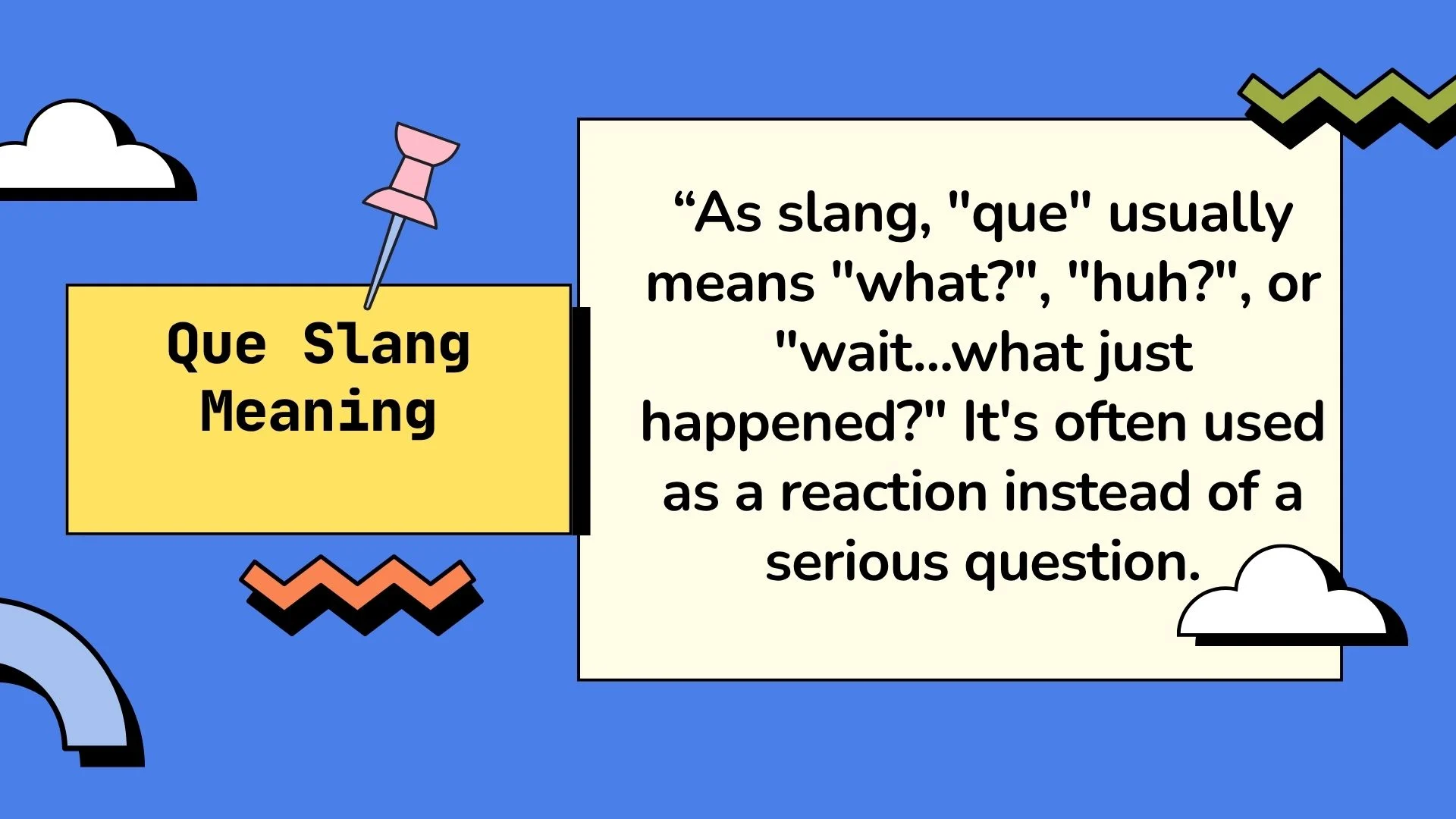
As slang, “que” usually means “what?”, “huh?”, or “wait…what just happened?” It’s often used as a reaction instead of a serious question.
Here are a few quick examples:
- Friend: “I accidentally deleted my entire project.”
You: “Que??” - Comment: “He quit his job to become a magician.”
Reply: “Que 😭” - Message: “We’re leaving in five minutes.”
Response: “Que? I thought we were going tomorrow.”
The exact tone depends on the conversation. Sometimes it’s genuine confusion. Other times it’s playful disbelief or mock shock.
Did you know?
The word “qué” has existed in Spanish for centuries, but its popularity in English-speaking social media exploded because bilingual users, memes, and TikTok creators mixed languages naturally. Today, plenty of people who don’t even speak Spanish casually type “que” as a reaction online.
Why people actually search this
Let’s be honest—most people don’t wake up wondering what “que” means.
They search it because they saw it in a TikTok comment, received it in a text, or matched with someone on a dating app who replied with only “que?” Suddenly they’re wondering whether they missed a joke, offended someone, or misunderstood the conversation.
Usually, none of those are true.
Most of the time, it’s simply another person’s way of saying, “Wait…what?” in a slightly more expressive or internet-friendly style.
How it sounds across different apps
Alex: “I just bought a motorcycle.”
Jamie: “Que?? You don’t even have a license.”
Caption: “I ran a marathon without training.”
Comment: “Que 😭 That’s actually wild.”
TikTok
Creator: “This recipe uses soda instead of water.”
Viewer: “Que? I need an explanation.”
Dating App
Match: “I own seven pet snakes.”
You: “Que? Okay, now I’m curious.”
Common mistake people make
One mistake is assuming “que” automatically means the same thing in every conversation.
If someone is actually writing in Spanish, que isn’t internet slang at all—it’s simply a normal Spanish word meaning “what” or functioning as a connecting word in many sentences.
Another mistake is overusing it in formal conversations. Sending “que???” in a work email would probably confuse people more than help.
Similar slang that feels close
If you’ve seen “huh?” or “wdym” (what do you mean?), they live in the same neighborhood as “que.”
The difference is that “que” often sounds more dramatic or meme-like, especially when paired with crying emojis or multiple question marks. Meanwhile, “wdym” usually asks for clarification, while “huh?” feels more conversational and direct.
People also search things like…
A lot of users type “what does que mean on TikTok?” The answer is usually simple: it’s a reaction showing surprise or confusion, often borrowed from Spanish.
Others search “is que Spanish?” Yes. The original word comes from Spanish, where qué means “what.”
Another common search is “why do people say que instead of what?” Mostly because internet culture blends languages, and some expressions simply become trendy through memes and social media.
How to reply like a native speaker
If someone messages you “Que?”, you can answer naturally with responses like:
- “Haha, I know. It surprised me too.”
- “Let me explain—it makes more sense with context.”
- “Exactly! That was my reaction too.”
These replies keep the conversation flowing without sounding stiff or overly formal.
The fun thing about internet slang is that words constantly travel between languages, communities, and platforms. “Que” is a perfect example. A simple Spanish word became a widely recognized online reaction because millions of people started using it naturally in comments, chats, and memes. The next time you spot “que” under a viral post or receive it in a message, you’ll know it’s probably not a mysterious code at all—just someone’s quick way of saying, “Wait…what did I just read?”

I’m Daniel Brooks, a writing expert dedicated to breaking down grammar into clear, practical lessons anyone can understand. I focus on helping you write with precision, confidence, and impact in every sentence. Discover more tips and guides at GrammarVibes.com.