The pinche slang meaning is one of the most searched topics among people learning Spanish or trying to understand conversations on social media. You may have seen the word pinche in Mexican movies, memes, TikTok videos, WhatsApp chats, or heard it in everyday conversations.
Because it is used in different situations, many people wonder whether it is an insult, a joke, or simply an expression for emphasis.
In reality, pinche is a versatile Spanish slang word that changes meaning depending on the speaker’s tone, context, and relationship with the listener. Sometimes it is playful and humorous, while in other situations it can sound offensive or disrespectful.
Understanding when and how it is used helps avoid misunderstandings, especially if you are communicating with native Spanish speakers.
This guide explains the pinche slang meaning, its history, common uses, examples, misconceptions, and how it appears across social media and online conversations.
Meaning & Definition of Pinche Slang Meaning
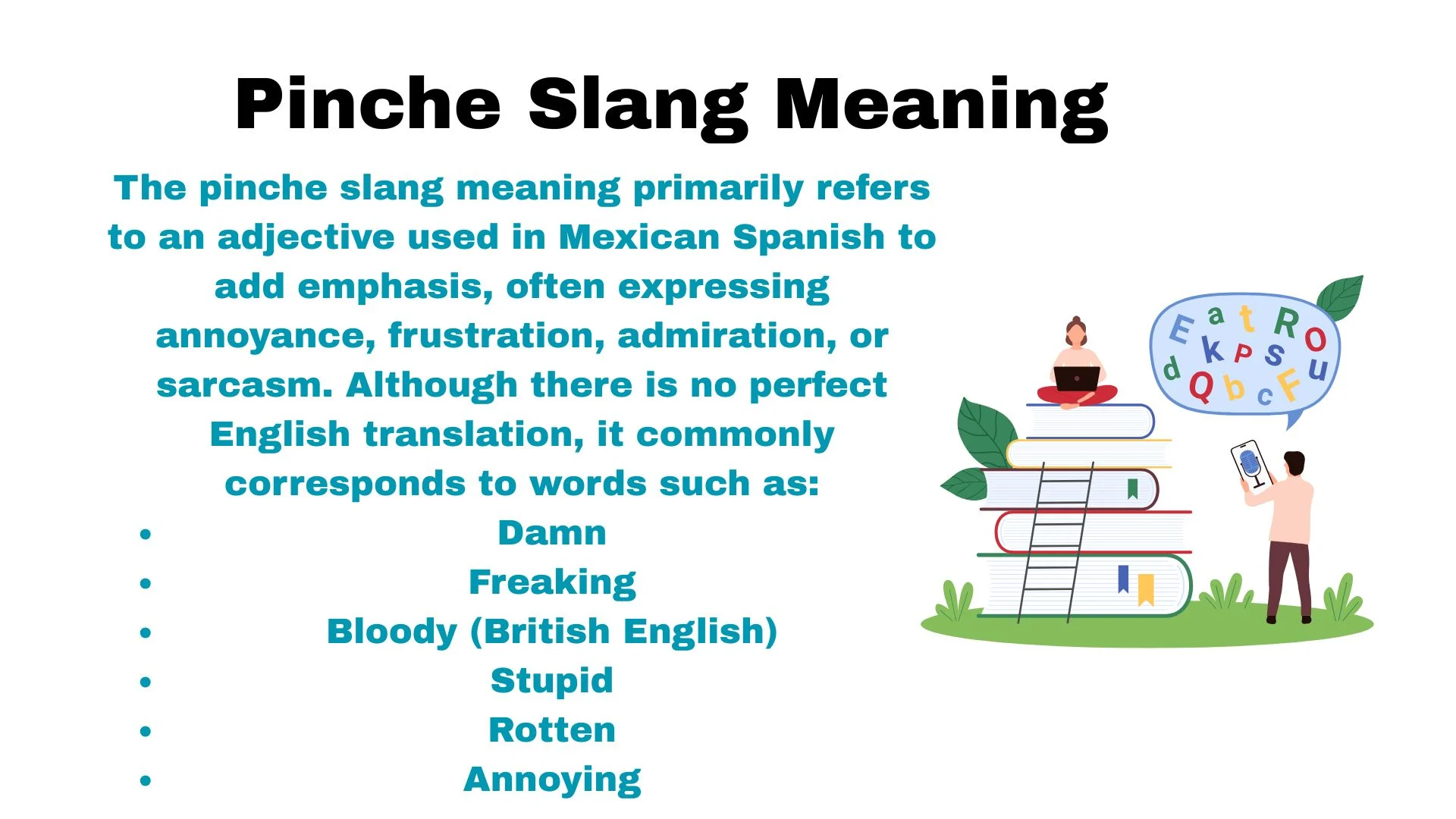
The pinche slang meaning primarily refers to an adjective used in Mexican Spanish to add emphasis, often expressing annoyance, frustration, admiration, or sarcasm. Although there is no perfect English translation, it commonly corresponds to words such as:
- Damn
- Freaking
- Bloody (British English)
- ignorant
- Rotten
- Annoying
Its exact meaning depends entirely on the sentence.
Examples
- Pinche tráfico.
- Damn traffic.
- Pinche calor.
- This freaking heat.
- Ese pinche perro.
- That annoying dog.
- Pinche genio.
- You freaking genius.
In many conversations, pinche simply intensifies the emotion rather than acting as a direct insult.
However, when directed toward a person, it may become offensive.
For example:
- Pinche mentiroso.
- You damn liar.
In casual conversations among close friends, the word may be used jokingly without causing offense.
Pinche Meaning
The word pinche is a common Spanish slang term, especially in Mexico, but its meaning depends on the situation and tone. Originally, pinche referred to a kitchen helper or assistant cook.
Today, however, it is mostly used as an intensifier before a noun or adjective. It can express anger, frustration, admiration, or emphasis, much like words such as “damn,” “ignorant” or “freaking” in English.
For example, “pinche tráfico” means “this damn traffic,” while “pinche genio” can mean “that freaking genius.” Because its meaning changes with context, it is not always offensive. Friends may use it jokingly, while strangers might find it rude.
If you’re learning Spanish or watching Mexican movies, you’ll hear pinche often. Understanding the speaker’s tone and relationship with the listener is the key to interpreting its true meaning.
Is Pinche a Bad Word?
Whether pinche is considered a bad word depends on where it is used and who says it. In Mexico, it is generally viewed as a mild swear word or vulgar expression rather than an extremely offensive insult. It is often used to show annoyance, such as saying “pinche clima” for “this annoying weather.”
Friends may also use it playfully without intending to offend anyone. However, saying “pinche idiota” or “pinche mentiroso” directly to someone can sound insulting and disrespectful. In formal settings, workplaces, schools, or conversations with people you do not know well, it is better to avoid using it.
While pinche is less severe than many stronger Spanish swear words, it is still considered informal and potentially offensive. If you are not a native speaker, using more neutral expressions is usually the safest choice.
Pinche Meaning in Mexico
In Mexico, pinche is one of the most frequently used slang words in everyday speech. It is commonly placed before another word to add emotion or emphasis. Depending on the situation, it can mean “damn,” “bloody,” “ignorant,” “lousy,” or simply “freaking.” For example, “pinche carro” can mean “this lousy car,” while “pinche suerte” translates to “damn luck.”
Interestingly, the same word can even express admiration, as in “pinche talento,” meaning “amazing talent.” Because Mexican Spanish relies heavily on tone and context, the exact translation changes from conversation to conversation.
Although many Mexicans use pinche casually with friends and family, it is still regarded as slang and may sound rude in professional or respectful situations. Visitors to Mexico will hear it often in movies, music, and daily conversations.
Pinche Meaning in Spanish
In the Spanish language, pinche has both a traditional and a modern meaning. Historically, it referred to a kitchen assistant or cook’s helper, a definition that still appears in many Spanish dictionaries. However, in modern conversation—particularly in Latin America—it has evolved into a slang intensifier.
Instead of describing a profession, it often emphasizes another word by adding emotion. Depending on context, it may be translated as “damn,” “bloody,” “ignorant,” or “freaking.” While this slang usage is especially common in Mexican Spanish, it is less common or even unfamiliar in some other Spanish-speaking countries.
Native speakers usually understand its intended meaning through tone, facial expressions, and context. If you are studying Spanish, remember that pinche is not universally used the same way across all regions, so its meaning may vary depending on the country.
Pinche Meaning in Nepali
There is no direct Nepali equivalent for pinche because its meaning changes based on context. When used to express frustration, it can be translated into Nepali with expressions like “धत्,” “मुजी,” “लौ न,” or other informal words depending on the level of emotion. If someone says “pinche tráfico,” the idea could be translated as “यो धत् ट्राफिक” or “यो झन्झटिलो ट्राफिक.”
When used as an insult, the Nepali translation depends on the target and situation rather than the word itself. Since pinche is a slang intensifier rather than a fixed insult, there is no single perfect translation. It is important to understand the speaker’s intention before translating it. In formal Nepali writing or polite conversation, it is usually better to replace pinche with a neutral expression instead of using a vulgar equivalent.
Pinche Meaning in Portuguese
In Portuguese, there is no exact one-word translation for pinche, but several expressions carry a similar feeling depending on context. If pinche is used to express annoyance, it may be translated as “maldito,” “droga de,” or “esse maldito.” For example, “pinche carro” could become “esse carro maldito” or “esse maldito carro.”
]In casual Brazilian Portuguese, people might also use slang expressions that serve a similar emotional purpose, although the exact wording varies by region. Since pinche is a Mexican Spanish slang word, translators usually focus on conveying the emotion rather than translating it literally.
The best Portuguese equivalent depends on whether the speaker is expressing anger, surprise, admiration, or humor. Understanding the conversation’s tone is essential for choosing the most natural and accurate Portuguese translation.
Background of the Word “Pinche”
The history of pinche is interesting because it originally had a completely different meaning.
Historically, pinche referred to a kitchen assistant or helper working under a chef. This meaning is still recognized in Spain, where restaurants may use pinche de cocina to describe an assistant cook.
Over time, especially in Mexico, the word evolved into slang.
Rather than referring to someone’s occupation, it became an emotional intensifier similar to saying:
- freaking
- darn
- blasted
- damn
Today, the slang version is deeply connected with Mexican culture and appears frequently in:
- TV shows
- Movies
- Comedy
- Street conversations
- Internet memes
Other Spanish-speaking countries may understand it, but its frequency and intensity vary significantly.
Pinche Slang Meaning in Different Contexts
The pinche slang meaning changes depending on where it is used.
Casual Conversation
Friends often use it jokingly.
Example:
Pinche amigo, siempre llegas tarde.
Translation:
“Dude, you always arrive late.”
Here it sounds playful.
Social Media
TikTok captions often include expressions like:
- Pinche lunes.
- Pinche algoritmo.
- Pinche internet.
These phrases express frustration humorously.
Gaming
Gamers commonly type:
- Pinche lag.
- Pinche camper.
This shows irritation toward gameplay.
Workplace
Professional environments generally avoid the word because it may sound rude.
Instead of saying:
Pinche computadora.
Most professionals would simply say:
This computer isn’t working.
Everyday Speech
Family members sometimes use it casually, though older generations may consider it disrespectful.
Pinche Slang Meaning in Chat, WhatsApp, Instagram, and TikTok
The pinche slang meaning is especially common on messaging apps and social platforms.
Friends may text:
Pinche, ya contesta.
Meaning:
“Dude, answer already.”
Captions often include:
Pinche clima.
Meaning:
“This weather is ridiculous.”
TikTok
Creators frequently exaggerate reactions using:
Pinche algoritmo.
Meaning:
“The algorithm is terrible.”
Gaming Chats
Players often type:
Pinche equipo.
Meaning:
“My team is awful.”
Because text messages lack vocal tone, readers should consider context before assuming someone is angry.
Meaning in Physics, Medical, and Aircraft Terminology
People sometimes search whether pinche slang meaning has technical definitions in professional fields.
Physics
There is no recognized physics meaning for pinche.
The confusion often comes from the English word pinch, as in:
- Pinch effect
- Pinch plasma
These are unrelated.
Medical
Medical professionals may use pinche de cocina in occupational discussions, but pinche itself is not a medical abbreviation or medical term.
Aircraft
There is no official aircraft terminology using pinche.
Aviation manuals do not recognize it as an abbreviation or technical expression.
In short, pinche remains a slang or ordinary Spanish word rather than technical vocabulary.
Common Misconceptions About Pinche Slang Meaning
Many learners misunderstand how pinche works.
Misconception 1: It always means a swear word.
Not true.
Sometimes it simply adds emphasis.
Misconception 2: It always insults someone.
No.
It can describe objects, situations, or even express admiration.
Misconception 3: Every Spanish-speaking country uses it the same way.
Incorrect.
Its strongest cultural association is with Mexican Spanish.
Misconception 4: It has one English translation.
There isn’t a perfect equivalent because meaning depends heavily on context.
Similar Terms & Alternatives
Several expressions serve similar purposes.
| Word | Meaning |
| Maldito | Damn |
| Maldito sea | Curse it |
| Carajo | Damn it |
| Rayos | Darn |
| Demonios | Heck |
| Chingado | Stronger Mexican slang |
| Freaking | English equivalent |
| Bloody | British equivalent |
These alternatives vary in politeness and regional use.
How to Respond to Pinche
Your response depends on the situation.
If used jokingly:
Jajaja, ya sé.
Translation:
“Haha, I know.”
If someone is frustrated:
Tranquilo.
Meaning:
“Relax.”
If the comment is offensive:
Remain calm and ask:
¿Por qué dices eso?
Translation:
“Why do you say that?”
Avoid escalating arguments because tone often matters more than the word itself.
Differences from Similar Words
Although pinche resembles other Spanish expressions, there are key differences.
Pinche vs. Chingado
- Pinche is usually milder.
- Chingado is generally much stronger.
Pinche vs. Maldito
- Maldito literally means cursed or damned.
- Pinche often functions only as emphasis.
Pinche vs. Güey
- Pinche describes emotion.
- Güey refers to a person, similar to “dude.”
Understanding these distinctions helps avoid awkward conversations.
Relevance in Online Conversations & Dating Apps
The pinche slang meaning appears frequently in digital communication.
On dating apps, users may write:
Pinche Tinder.
Meaning they are frustrated with the app.
Someone might jokingly say:
Pinche guapo.
Meaning:
“You’re ridiculously handsome.”
Whether this sounds flirtatious or sarcastic depends entirely on tone and relationship.
Memes also use pinche to exaggerate everyday problems.
Examples include:
- Pinche lunes.
- Pinche Wi-Fi.
- Pinche tráfico.
Because humor is common online, many uses are not intended as serious insults.
Conclusion
The pinche slang meaning reflects the colorful and expressive nature of Mexican Spanish. Although the word is often translated as “damn” or “freaking,” its real meaning depends on the context, tone, and relationship between the people involved.
It can express annoyance, humor, admiration, sarcasm, or frustration without always being offensive. While pinche is common in casual conversations, social media, memes, and messaging apps like WhatsApp, it is generally inappropriate for formal or professional settings.
It also has no recognized meaning in physics, medicine, or aircraft terminology despite common online searches. By understanding how native speakers use pinche, language learners can better interpret conversations, avoid misunderstandings, and communicate more naturally in Spanish-speaking environments.

I’m Daniel Brooks, a writing expert dedicated to breaking down grammar into clear, practical lessons anyone can understand. I focus on helping you write with precision, confidence, and impact in every sentence. Discover more tips and guides at GrammarVibes.com.