The phrase “mamma mia” is one of the most recognizable expressions in the world, often heard in movies, television shows, social media posts, and everyday conversations. Although it originated in the Italian language, it has become a popular slang expression used by English speakers to express strong emotions.
People frequently search for mamma mia slang meaning because they encounter it in chats, memes, TikTok videos, WhatsApp conversations, Instagram captions, or popular culture and want to understand what it actually means.
Depending on the situation, “mamma mia” can express surprise, excitement, shock, frustration, admiration, or disbelief. Unlike many internet slang terms, it is not an abbreviation or acronym.
Instead, it is a traditional expression that has gained modern popularity through entertainment, music, and online communication. Understanding its meaning and usage helps people interpret conversations correctly and use the phrase naturally in both casual and digital settings.
Meaning & Definition
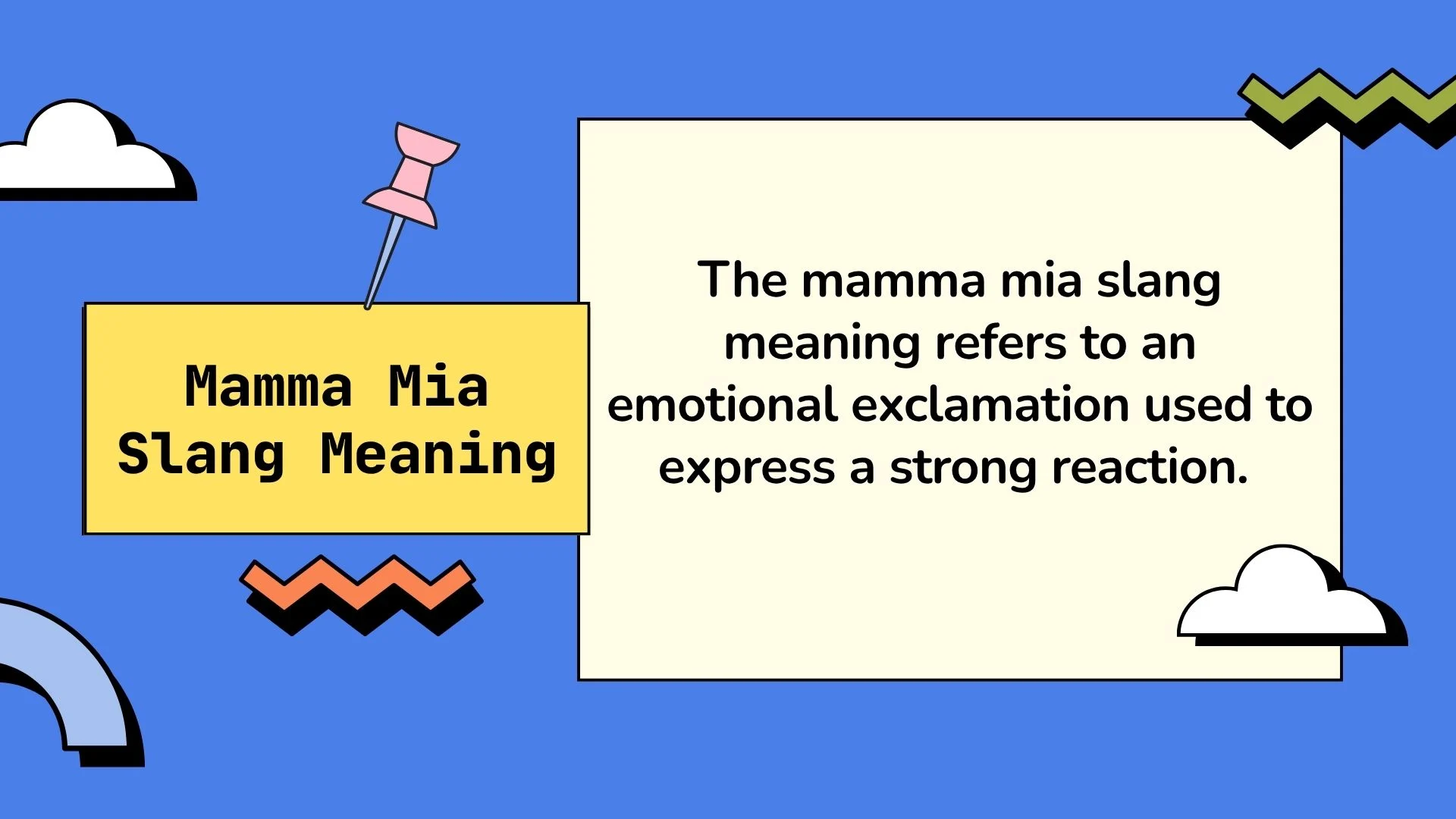
The mamma mia slang meaning refers to an emotional exclamation used to express a strong reaction. Literally translated from Italian, “mamma mia” means “my mother.” However, native speakers rarely use it to refer to their actual mother. Instead, it functions as an emotional expression similar to English phrases like:
- Oh my goodness!
- Oh my God!
- Wow!
- Good grief!
- No way!
- That’s unbelievable!
The exact meaning depends on the context and the speaker’s tone. It may express:
Surprise
Someone hears unexpected news and responds:
“Mamma mia! I didn’t see that coming.”
Amazement
A person sees something impressive.
“Mamma mia! That sunset is beautiful.”
Shock
Someone receives surprising information.
“Mamma mia! That was expensive.”
Frustration
The expression may also communicate annoyance.
“Mamma mia! I forgot my keys again.”
Unlike internet abbreviations such as LOL or BRB, “mamma mia” is a complete phrase that emphasizes emotion rather than conveying specific information. It is generally considered informal and is most commonly used in conversations, entertainment, and social media.
Background
The expression “mamma mia” has deep roots in the Italian language and culture. Italians have used it for generations as an emotional exclamation during moments of excitement, fear, joy, or disbelief. Over time, the phrase spread beyond Italy through immigration, films, music, and global entertainment.
Its popularity increased significantly through Hollywood movies featuring Italian characters, where the phrase became associated with expressive personalities. Later, the famous musical and movie Mamma Mia!, inspired by the songs of the Swedish pop group ABBA, introduced the expression to millions of people around the world.
Today, many English speakers recognize “mamma mia” even if they do not speak Italian. In online culture, the phrase has become a humorous reaction used in memes, GIFs, short videos, and comment sections.
Unlike newly created internet slang, this expression has survived for centuries because it communicates emotion in a simple and memorable way. Modern users often adopt it because it sounds dramatic, entertaining, and universally understandable.
Its widespread use across cultures demonstrates how language evolves as expressions travel from one country to another while maintaining their emotional meaning.
Usage in Different Contexts
The mamma mia slang meaning changes slightly depending on where it is used.
Everyday Conversation
Friends often use it during casual discussions.
Example:
“Mamma mia! That exam was difficult.”
Social Media
People use it as a reaction to funny, shocking, or impressive content.
Example:
“Mamma mia, this transformation is incredible!”
Entertainment
Actors and comedians frequently use it to exaggerate emotions, making scenes more expressive and humorous.
Gaming
Gamers may type it after unexpected victories or defeats.
Example:
“Mamma mia! That boss was impossible.”
Professional Settings
In workplaces, the phrase is uncommon because it is informal. While colleagues might jokingly say it during relaxed conversations, professional communication usually favors more neutral expressions such as:
- That’s surprising.
- That’s unexpected.
- Incredible.
- Impressive.
Although understandable worldwide, “mamma mia” remains best suited for informal communication where emotional reactions are acceptable.
Meaning in Chat, WhatsApp, Instagram, TikTok
Digital communication has given mamma mia slang meaning even greater popularity.
In Chat
It usually expresses immediate surprise.
Example:
Friend: “I won the lottery.”
Reply: “Mamma mia!”
On WhatsApp
People use it when reacting to unexpected news, funny pictures, or surprising voice notes.
Example:
“Mamma mia 😂 I can’t believe you actually did that!”
On Instagram
The phrase commonly appears in captions celebrating beautiful scenery, fashion, food, or travel.
Example:
“Mamma mia! Italy is absolutely stunning.”
On TikTok
Creators often use it dramatically during funny edits, cooking videos, travel content, or unexpected plot twists.
Example:
“Mamma mia! Wait until the end!”
The phrase works well because it instantly communicates emotion without needing additional explanation. Emojis such as 😲😂😍😱 are frequently paired with it to strengthen the emotional impact.
Meaning in Physics, Medical, and Aircraft Terminology
Many people wonder whether mamma mia slang meaning has technical definitions in science or professional industries.
Physics
The phrase has no official meaning in physics. Scientists do not use “mamma mia” as a scientific term, equation, unit, or abbreviation.
Medical Field
There is no recognized medical terminology using “mamma mia.” Healthcare professionals generally do not use it in clinical documentation or medical communication. Patients may say it informally to express pain, surprise, or anxiety, but it has no medical definition.
Aircraft Terminology
In aviation, “mamma mia” is not an official aviation term, code, abbreviation, or aircraft procedure. Pilots, air traffic controllers, and aviation engineers rely on standardized terminology rather than emotional expressions.
Therefore, if you encounter “mamma mia” in technical discussions related to physics, medicine, or aviation, it is almost certainly being used as an informal emotional reaction rather than as specialized terminology.
Common Misconceptions
Several misunderstandings surround the phrase.
It Always Means “Oh My God”
Not exactly. While similar, “mamma mia” expresses a wide range of emotions, including excitement, amazement, admiration, frustration, or disbelief.
It Is Only Used by Italians
False. Millions of English speakers and people from other countries use it regularly.
It Is an Internet Acronym
Unlike LOL, OMG, or BRB, “mamma mia” is a complete phrase rather than an abbreviation.
It Is Offensive
Generally, no. It is considered a mild and polite expression suitable for most informal situations.
It Always Refers to Someone’s Mother
Although the literal translation is “my mother,” modern usage rarely refers to an actual parent. Instead, it functions as an emotional exclamation.
Understanding these misconceptions helps users interpret the phrase correctly across different situations.
Similar Terms & Alternatives
Several expressions convey emotions similar to mamma mia.
- Oh my goodness!
- Oh my God!
- Wow!
- Good grief!
- Holy cow!
- No way!
- Incredible!
- Seriously?
- Unbelievable!
- What on earth!
Each alternative varies slightly in tone.
For example:
- Wow emphasizes admiration.
- Good grief often expresses frustration.
- No way signals disbelief.
- Holy cow adds humor.
- Mamma mia sounds more dramatic and expressive due to its Italian origin.
Choosing the right alternative depends on the emotion and audience.
How to Respond to It
Responding appropriately depends on the situation.
If someone says:
“Mamma mia! That’s amazing!”
Possible replies include:
- I know, right?
- It’s unbelievable.
- Exactly!
- Isn’t it incredible?
- I couldn’t believe it either.
If someone expresses frustration:
“Mamma mia! I missed my flight.”
Suitable responses include:
- That’s unfortunate.
- I hope everything works out.
- Better luck next time.
- That must be frustrating.
When used humorously, matching the speaker’s enthusiasm usually creates a natural conversation.
Differences from Similar Words
Although mamma mia resembles several emotional expressions, important differences exist.
| Expression | Primary Emotion | Typical Usage |
| Mamma mia | Surprise, amazement, frustration | Informal conversations |
| OMG | Shock or excitement | Online chats and texting |
| Wow | Admiration | Universal situations |
| Good grief | Frustration | Casual English |
| No way | Disbelief | Informal conversations |
| Holy cow | Surprise with humor | Friendly conversations |
Unlike abbreviations such as OMG, “mamma mia” sounds more expressive and theatrical. It often adds personality and dramatic effect rather than simply communicating surprise.
Relevance in Online Conversations & Dating Apps
The mamma mia slang meaning remains highly relevant in today’s digital communication.
On dating apps, users may use it playfully after seeing an impressive profile or receiving surprising information.
Examples include:
- “Mamma mia, your travel photos are amazing!”
- “Mamma mia, you’re really funny.”
In online conversations, the phrase helps make messages feel more expressive and conversational. Since written text lacks vocal tone, emotional expressions like “mamma mia” help communicate excitement, humor, or surprise more effectively.
It is also widely used in memes, reaction GIFs, short-form videos, and comment sections because it instantly conveys emotion without requiring lengthy explanations.
Although modern slang changes rapidly, “mamma mia” has remained popular because it is easy to understand, emotionally expressive, and recognized by audiences across different cultures and age groups.
Conclusion
The mamma mia slang meaning centers on expressing strong emotions such as surprise, excitement, amazement, frustration, or disbelief. Originally an Italian expression meaning “my mother,” it has evolved into a globally recognized exclamation that appears in everyday conversations, entertainment, social media, messaging apps, and online communities.
Unlike internet abbreviations, it is a complete phrase that adds personality and emotion to communication. It has no official technical meaning in physics, medicine, or aviation, making its use almost entirely informal.
If appearing in WhatsApp chats, Instagram captions, TikTok videos, memes, or dating apps, “mamma mia” continues to be a versatile expression that helps people react naturally to unexpected situations. Understanding its meaning, history, contexts, and alternatives allows speakers and readers to recognize the phrase accurately and use it confidently in modern communication.