If you’ve ever spent time online—whether gaming, chatting, or scrolling through social media—you’ve likely come across the term “GG.” Short, simple, and widely used, it’s one of those internet expressions that can mean different things depending on the context. People often search for gg slang meaning to understand if it’s positive, sarcastic, or even rude in certain situations.
Originally popular in gaming communities, “GG” has expanded far beyond its roots. Today, it appears in WhatsApp messages, TikTok comments, Instagram captions, and even professional conversations. While it often stands for “good game,” its tone can vary from genuine praise to subtle sarcasm.
Understanding how and when to use “GG” correctly can help you communicate more effectively online and avoid misunderstandings. In this article, we’ll break down its meaning, origin, and modern usage across different platforms and contexts.
Meaning & Definition
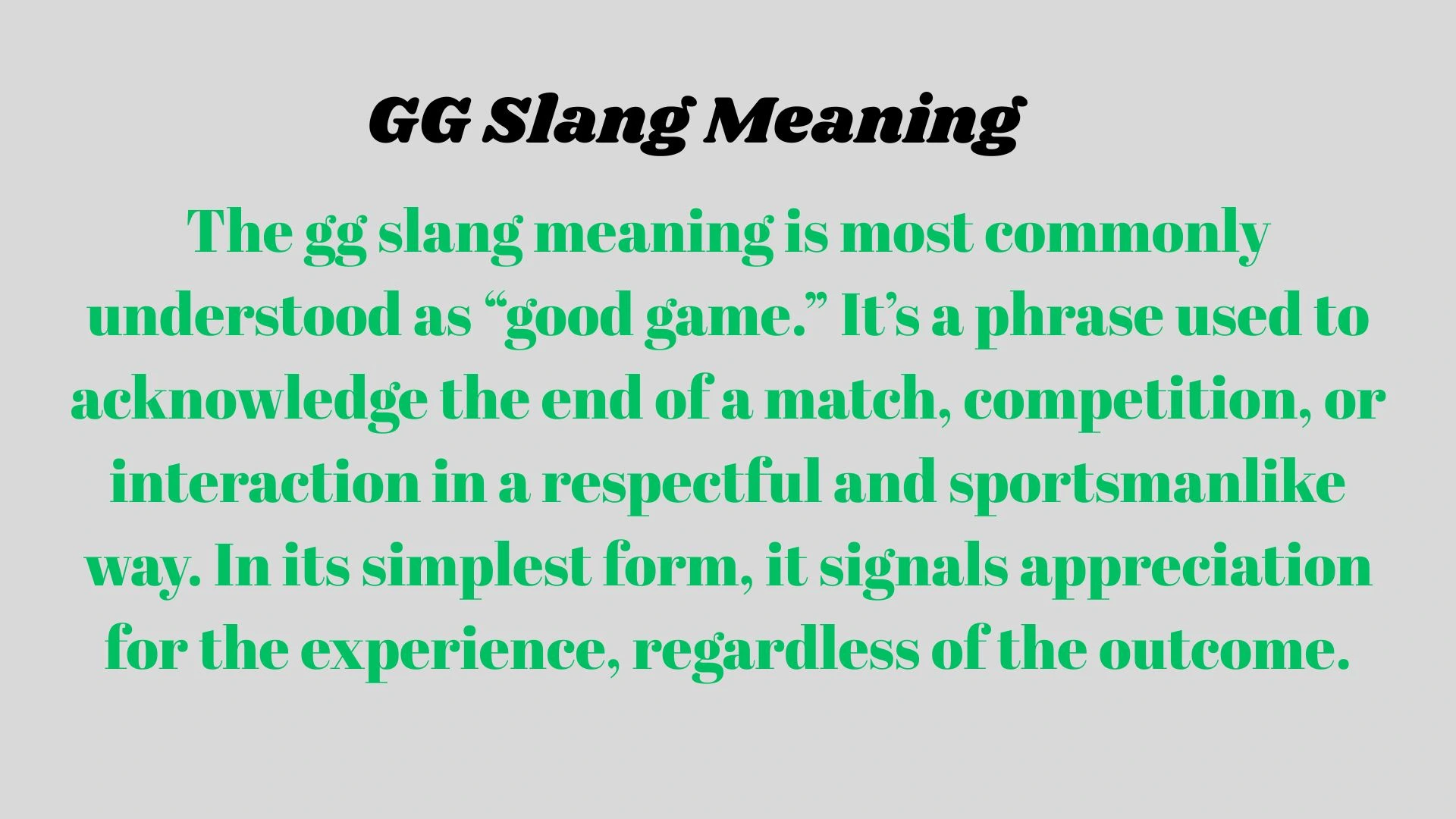
The gg slang meaning is most commonly understood as “good game.” It’s a phrase used to acknowledge the end of a match, competition, or interaction in a respectful and sportsmanlike way. In its simplest form, it signals appreciation for the experience, regardless of the outcome.
However, like many internet slang terms, “GG” isn’t limited to one definition. It can also carry additional meanings depending on tone and context. For example:
- Positive use: “GG, that was fun!” (genuine appreciation)
- Neutral use: “GG” (a simple acknowledgment)
- Sarcastic use: “GG, we lost in 2 minutes…” (mocking or frustration)
In broader conversations, “GG” can also imply that something is over or beyond recovery. For instance, if someone says, “My phone just died—GG,” they’re suggesting the situation is finished or hopeless.
The flexibility of “GG” is what makes it so popular. It’s short, easy to type, and adaptable across different emotional tones. Still, understanding the context is key, as the same two letters can either convey respect or sarcasm.
Background with Examples
The origin of the gg slang meaning comes from early online multiplayer gaming communities in the late 1990s and early 2000s. Games like StarCraft, Counter-Strike, and Warcraft popularized the term, where players would type “GG” at the end of a match as a sign of sportsmanship.
Over time, “GG” became a standard part of gaming etiquette. In competitive gaming, especially esports, saying “GG” is often expected. Not saying it can even be perceived as rude or unsportsmanlike.
Here are some common examples from its early use:
- After a close match: “GG, well played!”
- After a loss: “GG, you were better.”
- After a quick defeat: “GG, that was fast.”
As internet culture evolved, “GG” moved beyond gaming into everyday digital conversations. It began appearing in forums, chatrooms, and eventually social media platforms.
For example:
- A student finishes exams: “Finally done—GG!”
- Someone fails a challenge: “I tried… GG.”
- A funny fail video: “He slipped at the end, GG 😂”
This evolution shows how a term rooted in gaming culture has transformed into a universal expression used to mark endings, outcomes, or reactions to situations.
Usage in Different Contexts
The gg slang meaning varies widely depending on where and how it’s used. In gaming, it retains its original purpose—signaling respect and closure. In casual conversations, it can indicate acceptance of an outcome, whether positive or negative.
Chat & Social Media
In everyday chat, “GG” is often used humorously or casually:
- “Missed the bus again… GG.”
- “That presentation went great—GG!”
On platforms like Twitter or Reddit, it may appear in reactions to news or events, sometimes with sarcasm.
Professional Fields
In professional environments, “GG” is less common but may still appear in informal team chats or tech-related workplaces. However, it’s generally best avoided in formal communication, as it may seem unprofessional or unclear to those unfamiliar with slang.
Meaning in Chat, WhatsApp, Instagram, TikTok
Across messaging and social platforms, the gg slang meaning adapts to tone and audience:
- WhatsApp: Casual acknowledgment or humor (“GG, we’re late again”)
- Instagram: Often used in captions or comments to react to wins, fails, or funny moments
- TikTok: Frequently appears in comments, sometimes sarcastic or meme-driven
- Chat apps: Used quickly to end a conversation or acknowledge something
On these platforms, emojis often accompany “GG” to clarify tone, such as 😂 for humor or 😅 for awkward situations.
Meaning in Physics, Medical, and Aircraft Terminology
Outside slang, “GG” can have entirely different meanings in technical fields:
- Physics: “g” refers to gravitational force; “GG” may informally emphasize strong force (though not standard terminology)
- Medical: “GG” can refer to “gamma globulin,” a type of protein in the blood
- Aircraft/Aviation: “G” represents gravitational force experienced by pilots; “GG” isn’t standard but may appear informally
These meanings are context-specific and rarely overlap with slang usage.
Common Misconceptions
One common misunderstanding about the gg slang meaning is that it’s always positive. In reality, tone plays a huge role.
Some people assume “GG” is always polite, but in certain contexts, it can be sarcastic or even passive-aggressive. For example:
- “GG, you ruined it” clearly carries a negative tone
Another misconception is that it’s only used in gaming. While that’s where it started, it’s now widely used across all digital platforms.
Similar Terms & Alternatives
Several expressions carry a similar meaning to “GG,” depending on the context:
- WP (Well Played): Often used alongside GG in gaming
- NT (Nice Try): Encourages effort
- RIP: Indicates failure or something ending
- LOL: Expresses amusement rather than closure
- Well done: A more formal alternative
Each term has its own nuance, but they often overlap in casual conversation.
How to Respond to It
Responding to “GG” depends on the tone and situation.
- Positive context: “GG! That was fun.”
- Neutral context: “GG” (simple acknowledgment)
- Sarcastic context: You can respond with humor or ignore it
In gaming, it’s common etiquette to reply with “GG” as well, reinforcing mutual respect.
Differences from Similar Words
While “GG” shares similarities with terms like “WP” or “RIP,” it serves a unique purpose.
- GG vs WP: “GG” marks the end; “WP” praises performance
- GG vs RIP: “GG” can be neutral; “RIP” is usually negative
- GG vs LOL: “GG” signals closure; “LOL” expresses laughter
Understanding these differences helps avoid confusion and improves communication clarity.
Relevance in Online Conversations & Dating Apps
The gg slang meaning has even found its way into dating apps and online conversations. Here, it’s often used humorously or playfully.
For example:
- After a bad date: “Well… GG 😂”
- When a conversation ends awkwardly: “Guess that’s GG”
It can signal closure without being overly serious, making it useful in lighthearted or casual interactions.
Conclusion
The gg slang meaning has evolved from a simple gaming phrase into a versatile expression used across digital communication. While it originally stood for “good game,” it now represents much more—ranging from genuine appreciation to humor and even sarcasm.
Its popularity comes from its simplicity and adaptability. Whether you’re chatting with friends, commenting on social media, or wrapping up a game, “GG” offers a quick way to express your reaction. However, context is everything. The same phrase can feel friendly or sarcastic depending on how it’s used.
By understanding its meanings, origins, and variations, you can use “GG” more effectively and interpret it correctly in different situations. As online language continues to evolve, “GG” remains a small but powerful example of how digital communication shapes the way we interact.