If you’ve ever come across the term “ISO” in a chat, caption, or online post and wondered what it means, you’re not alone. The phrase ISO slang meaning is widely searched because this short abbreviation appears in many different contexts—from social media platforms like Instagram and TikTok to professional fields like photography and aviation.
Its meaning can shift depending on how and where it’s used, which can make it confusing for beginners.
In casual conversations, “ISO” often stands for something completely different than in technical fields. That’s why understanding its context is key. Whether you’re scrolling through WhatsApp messages, browsing online marketplaces, or learning industry-specific jargon, knowing how to interpret “ISO” can save you from misunderstandings.
This article breaks down the meaning, origin, and various uses of “ISO” in simple terms, helping you understand exactly what people mean when they use it.
Meaning & Definition
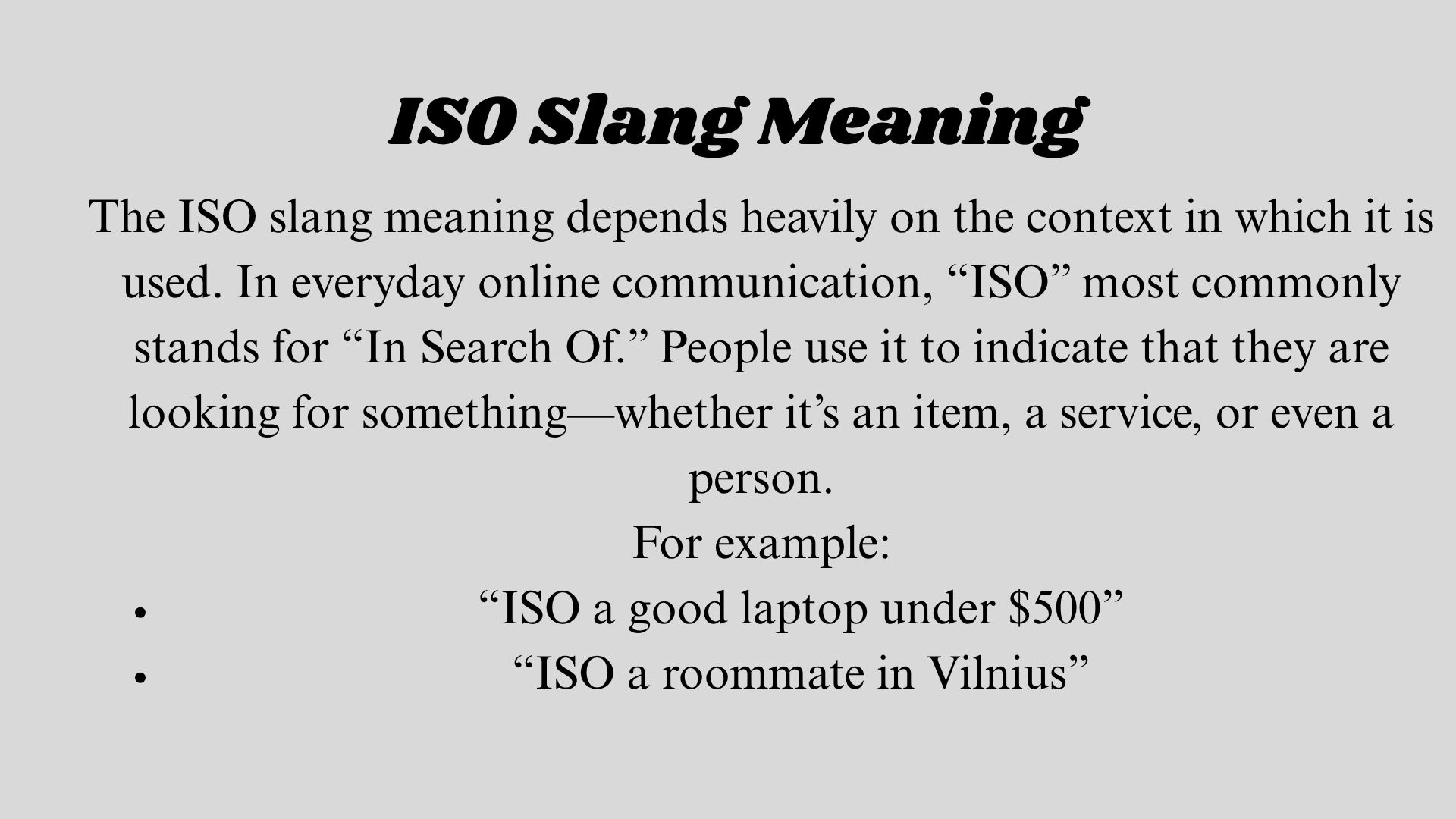
The ISO slang meaning depends heavily on the context in which it is used. In everyday online communication, “ISO” most commonly stands for “In Search Of.” People use it to indicate that they are looking for something—whether it’s an item, a service, or even a person.
For example:
- “ISO a good laptop under $500”
- “ISO a roommate in Vilnius”
In these cases, “ISO” acts as a quick and efficient way to express a need or request. It’s especially popular in online marketplaces, Facebook groups, and community forums where people frequently buy, sell, or trade items.
However, outside of slang usage, “ISO” can have entirely different meanings. In technical contexts, it often refers to the International Organization for Standardization, which sets global standards across industries. In photography, it relates to camera sensitivity to light, and in computing, it can refer to a disk image file format.
Because of these varied meanings, the key to understanding “ISO” lies in recognizing the context. In casual chats, it’s almost always “In Search Of,” while in professional settings, it carries a more technical definition.
Background
The origin of the slang version of “ISO” comes from classified ads and early internet forums. Before social media became popular, people used abbreviations to save space and time when posting listings in newspapers or online bulletin boards. “ISO” quickly became a convenient shorthand for “In Search Of.”
As online communities grew, especially on platforms like Craigslist, Reddit, and Facebook Marketplace, the abbreviation spread rapidly. It became a standard way for users to signal they were looking for something specific. Over time, it transitioned into everyday digital communication, including texting and social media posts.
Meanwhile, the technical meaning of “ISO” has a completely different history. The International Organization for Standardization was founded in 1947 to create global standards for products and services. Its abbreviation, “ISO,” is derived from the Greek word “isos,” meaning equal.
In photography, “ISO” refers to the sensitivity of a camera sensor to light, a concept that evolved from film photography. In aviation, “ISO” may appear in technical documentation related to standards and procedures.
These multiple origins explain why “ISO” can feel confusing—it’s a single abbreviation with several independent meanings that developed in different fields over time.
Usage in Different Contexts (Chat, Social Media, Professional Fields)
The ISO slang meaning changes depending on where it appears, making context essential for interpretation.
In chat and messaging, “ISO” is informal and direct. People use it to quickly express what they’re looking for without writing a full sentence. For instance, “ISO recommendations for a good restaurant” is a common message in group chats.
On social media platforms, the term is widely used in captions and posts. On Facebook groups, especially buy-and-sell communities, “ISO” is almost a standard label. On Instagram and TikTok, it can appear in captions when users are searching for products, collaborators, or advice.
In professional fields, however, “ISO” usually has nothing to do with searching. Instead, it refers to official standards or technical specifications. For example:
- In business: “ISO-certified company”
- In tech: “ISO file”
- In manufacturing: “ISO standards compliance”
Because of this dual usage, misunderstandings can happen if someone assumes the slang meaning in a professional setting or vice versa.
Understanding the audience and platform helps determine whether “ISO” is being used casually or technically.
Meaning in Chat, WhatsApp, Instagram, TikTok
On messaging apps and social platforms, the ISO slang meaning is almost always “In Search Of.”
- WhatsApp: Used in group chats when asking for help or recommendations.
- Example: “ISO a reliable plumber ASAP.”
- Instagram: Appears in captions or stories when users are looking for services, products, or collaborations.
- Example: “ISO photographers for a shoot.”
- TikTok: Often used in video captions or comments, especially when creators are seeking something specific or engaging their audience.
- Example: “ISO this outfit—anyone know where to buy it?”
The tone is usually casual and friendly, making it easy for others to respond. It’s a quick way to crowdsource information or connect with people who can help.
In these environments, “ISO” is widely understood, especially among younger users and active online communities.
Meaning in Physics, Medical, and Aircraft Terminology
Outside of slang, “ISO” has precise meanings in technical fields.
In physics and photography, ISO refers to a camera’s sensitivity to light. A lower ISO (e.g., 100) means less sensitivity and clearer images, while a higher ISO (e.g., 1600) increases sensitivity but may add noise.
In medical terminology, “ISO” may appear as a prefix meaning “equal” or “same,” derived from Greek. It can also be shorthand in notes, though this varies by context.
In aviation and aircraft industries, “ISO” often relates to standardized procedures and guidelines established by the International Organization for Standardization. These standards ensure safety, consistency, and quality across global operations.
Unlike slang, these meanings are formal and require subject-specific knowledge. Misinterpreting them as “In Search Of” in these contexts would lead to confusion.
Common Misconceptions
One of the biggest misunderstandings about the ISO slang meaning is assuming it always means the same thing everywhere. Many people believe “ISO” only stands for “In Search Of,” which is true in casual communication—but not in professional or technical contexts.
Another misconception is that “ISO” is a modern internet invention. While it became popular online, its use actually dates back to older classified ads and print listings.
Some users also confuse “ISO” with similar abbreviations like “IMO” (In My Opinion) or “ICYMI” (In Case You Missed It). These acronyms serve completely different purposes, even though they may appear in similar contexts.
Clearing up these misconceptions helps ensure accurate communication, especially when switching between casual and professional environments.
Similar Terms & Alternatives
There are several alternatives to “ISO” that convey a similar idea, depending on tone and context:
- LF (Looking For)
- WTB (Want To Buy)
- Searching for
- Need recommendations for
- Any suggestions for
These alternatives may feel more natural in certain situations, especially in formal writing or professional communication. While “ISO” is efficient, it can sometimes appear too informal outside of casual settings.
How to Respond to It
When someone uses “ISO,” the best response is to provide helpful information related to what they’re searching for.
For example:
- If someone says, “ISO a good restaurant,” you can reply with suggestions.
- If they say, “ISO a job opportunity,” you might share leads or advice.
If you don’t have a direct answer, you can still engage by asking follow-up questions or tagging someone who might help. The goal is to contribute to the search in a meaningful way.
Understanding the intent behind “ISO” makes responding easier and more effective.
Differences from Similar Words
“ISO” differs from other abbreviations because it specifically signals a request or need.
- ISO vs. LF: Both mean the same, but “ISO” is more common in community posts.
- ISO vs. WTB: “WTB” is specifically about purchasing, while “ISO” can include services or advice.
- ISO vs. Asking: “ISO” is shorter and more direct, often used in informal settings.
These differences may seem small, but they help refine communication depending on the situation.
Relevance in Online Conversations & Dating Apps
The ISO slang meaning has become increasingly relevant in online interactions, including dating apps. People use it to express what they’re looking for in a partner or experience.
For example:
- “ISO someone who loves travel”
- “ISO a serious relationship”
This usage helps users quickly communicate their intentions, saving time and avoiding confusion. It’s also popular in niche communities where people share specific interests or goals.
Because of its simplicity, “ISO” continues to thrive in digital communication, making it a valuable term to understand.
Conclusion
Understanding the ISO slang meaning comes down to recognizing context. In casual communication, it almost always means “In Search Of,” helping people quickly express what they’re looking for.
However, in technical and professional fields, “ISO” carries entirely different meanings related to standards, photography, or specialized terminology.
Its versatility is what makes it both useful and potentially confusing. By paying attention to where and how it’s used, you can easily interpret its intended meaning. Whether you’re chatting on WhatsApp, posting on Instagram, or reading technical documents, knowing the difference ensures clear and effective communication.
As digital language continues to evolve, abbreviations like “ISO” remain essential tools for fast and efficient interaction.